

The “Surprise” Doctrine: 4 Impactful Realities from the Most Awkward Meeting in Modern Diplomacy
1. Introduction: The Hook
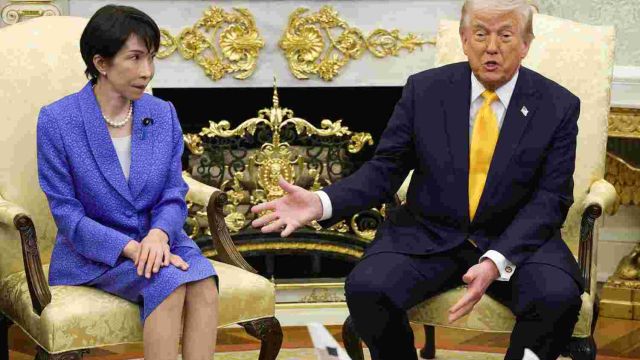
We have all navigated the skin-crawling friction of a social faux pas that agonizing moment when a guest says exactly the wrong thing at the most inopportune time. But when that friction occurs in the Oval Office between the leaders of the world’s most interconnected economies, the stakes graduate from mere social awkwardness to profound geopolitical instability. In March 2026, the diplomatic world witnessed such a rupture during the visit of Japan’s first female Prime Minister, Sanae Takaichi, to Washington D.C.
Takaichi arrived in the capital not as a supplicant, but as a leader with a formidable mandate, having recently secured a landslide electoral victory. She is a known conservative nationalist a leader who has historically argued that Japan fought a “defensive war” and has pushed back against what she views as excessive apologies for her nation’s past. Yet, even her seasoned political skin was not thick enough for the surrealism that awaited her. What was intended as a high-level summit to secure billions in investment and stabilize a fractured energy market quickly devolved into a jarring, unscripted debate over the darkest chapters of the 20th century.
The meeting was framed by a paradox: Takaichi came to manage the fallout of the February 28 U.S. strikes on Iran a conflict that is currently strangling the Japanese economy while offering historic levels of investment into American industry. Instead of gratitude, she was met with a rhetorical “Surprise Doctrine” that weaponized historical trauma as casual leverage. How did a visit intended to solidify a multi-billion dollar alliance turn into a debate about the “element of surprise” at Pearl Harbor? The answer reveals a Washington that has traded the role of a predictable protector for that of a geopolitical wildcard.
2. The “Pearl Harbor” Retort: When History Becomes a Punchline
The summit’s descent into the surreal began when a Japanese journalist asked President Trump why the United States had failed to notify its allies before launching the Iran strikes. Trump’s defense was not grounded in military protocol or shared intelligence pacts, but in a blunt, historically provocative analogy. He argued that the success of the mission relied on the “element of surprise,” and then, in a breathtaking breach of etiquette, he turned that tactical necessity into a rhetorical grenade aimed directly at his guest.
Trump effectively compared a modern military operation against a common adversary to the “date of infamy” that launched the bloody Pacific theater of World War II. For a sitting U.S. president to invoke a tragedy that claimed over 2,400 American lives as a “gotcha” against a present-day ally left the room in a stunned, heavy silence.
“We didn’t tell anybody about it because we wanted surprise. Who knows better about surprise than Japan, OK? Why didn’t you tell me about Pearl Harbor, OK?” – Donald Trump
This was not an isolated lapse in judgment, but part of a discernible pattern of behavior what some have dubbed a strategy of “diplomatic disorientation.” It mirrored a similar gaffe a year prior when Trump told German Chancellor Friedrich Merz that the D-Day landings were “not a pleasant day” for Germany, ignoring the nuance that the Allied invasion served as the liberation of Germany from Nazi tyranny. For Takaichi, a nationalist herself, the irony was layered: she sat in silence, visibly startled and fidgeting with her watch, as an American leader lectured her on the very history she has spent her career attempting to reframe.
3. The Unthinkable Comparison: Iran Strikes vs. Hiroshima
If the Pearl Harbor retort was a rhetorical grenade, the comparison Trump drew between the Iran strikes and the atomic bombings of 1945 was a wholesale demolition of the post-war consensus. In defending the “obliteration” of Iranian nuclear sites, Trump suggested that the strikes ended a threat in the same decisive manner that the bombings of Hiroshima and Nagasaki ended World War II.
This framing was met with visceral condemnation across Japan, a nation whose modern identity is built upon the unique trauma of being the only country to suffer nuclear attacks. The comparison was viewed not merely as a historical error, but as a moral “unacceptable” provocation. The reaction from the Nihon Hidankyo the Nobel Peace Prize-winning advocacy group representing atomic bomb survivors was swift and filled with indignation.
“If Trump’s comments justifies the dropping of the atomic bomb, it is extremely regrettable for us as a city that was bombed.” – Shiro Suzuki, Mayor of Nagasaki.
By equating a conventional strike on a nuclear program with the events that killed 140,000 people in Hiroshima alone, Trump ignored the central pillar of Japan’s national soul: its anti-nuclear advocacy. For the Hibakusha (survivors), the President’s comments were seen as a justification of their suffering to serve a modern political narrative, signaling a Washington that no longer respects the “sacred” boundaries of its allies’ historical scars.
4. The $134 Billion Squeeze: Paying for a War You Didn’t Start
Beyond the rhetorical fireworks lies a cold, transactional reality that highlights the “bear trap” nature of modern diplomacy. Japan currently finds itself in a crippling economic bind: it is the world’s fifth-largest oil importer, with a staggering 95% of its supply originating in the Middle East. The U.S.-led war in Iran has sent energy prices into the stratosphere and decimated the yen, effectively taxing every Japanese citizen at the grocery store and the pump.
Despite this, the Takaichi administration has been forced to “step up” to Trump’s demands for burden-sharing. To keep the alliance alive, Takaichi arrived with a massive peace offering: a pledge of $73 billion in new U.S. investments. This was a strategic second round of funding aimed at securing a vital trade deal to lower tariffs on Japanese goods from 25% to 15%.
The irony is profound and painful. Takaichi is presiding over a 21.3 trillion yen ($134 billion) domestic stimulus program back home just to keep the Japanese economy afloat essentially funding a domestic rescue mission necessitated by a conflict Japan did not start, while simultaneously pouring billions into the economy of the ally responsible for the instability. It is a portrait of an alliance where the price of “protection” is becoming nearly as high as the cost of the threat itself.
5. The Death of the “Security Umbrella” and the Nuclear Question
The most significant long-term takeaway from this meeting is the accelerating erosion of the U.S. “security umbrella.” For eighty years, the predictability of American protection allowed Japan to maintain its pacifist constitution and focus on becoming an economic powerhouse. However, Trump’s “America First” unpredictability and his repeated assertions that allies are “free-riders” are forcing Tokyo to consider a future that was previously unthinkable.
Japan is no longer looking solely to Washington for its survival. We are seeing a decisive shift toward “middle power” coalitions, with Japan aggressively cultivating deeper security ties with nations like Canada and Australia to uphold a rules-based order that feels increasingly abandoned by the United States.
Most shockingly, the perceived lack of U.S. reliability has brought the “nuclear question” into the mainstream of Japanese political discourse. For a nation defined by its post-war pacifism and the legacy of Hiroshima, the mere mention of acquiring nuclear weapons marks a seismic shift in global security. If the “umbrella” is being used as a tool for transactional mockery rather than a reliable shield, Japan may find itself pushed toward re-militarization as a matter of existential necessity.
6. Conclusion: A New Global Reality
The March 2026 summit was more than just a series of awkward exchanges; it was a preview of a world where diplomacy is stripped of its traditional solemnity and replaced by the raw mechanics of leverage. When a superpower stops acting as a predictable protector and starts acting as a wildcard, the rules of the game are rewritten in real-time.
Prime Minister Takaichi’s startled silence in the Oval Office serves as a metaphor for the broader international community. Nations that once relied on the stability of the American-led order are now being forced to choose between the high cost of a transactional alliance and the dangerous, uncertain path of self-reliance. As we watch the pillars of the post-war consensus continue to lean, we are left with a haunting question: When a superpower stops acting as a predictable protector and starts acting as a wildcard, does the ‘rules-based order’ survive, or are we all just waiting for the next surprise?


Leave a Reply