

The Gaulish Shield Goes Global: 5 Takeaways from France’s High-Stakes Nuclear Pivot
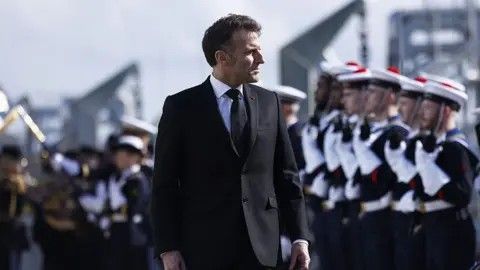
Standing before the salt-sprayed concrete of the Île Longue nuclear submarine base in Brittany on March 2, 2026, President Emmanuel Macron did more than just deliver a speech. Amidst the fifth year of the war in Ukraine and a Middle East teetering on the edge of a wider conflagration with Iran, the French Commander-in-Chief signaled the end of a thirty-year strategic slumber.
By choosing to maintain this address despite the “geopolitical upheaval” elsewhere, Paris is effectively tearing up the post-Cold War playbook. The message is clear: in an era of wavering traditional alliances and expanding military powers, France is pivoting from a purely national “Gaulish Shield” to a more aggressive, Eurocentric deterrent.
1. Breaking the 30-Year Plateau: An Expanding Arsenal
In a historic reversal of the post-1992 disarmament trend, France has announced its first increase in nuclear warhead numbers in over three decades. Since the end of the Cold War, the French arsenal had plateaued at a static count of approximately 290 warheads.
This pivot is not merely a whim of the executive but is anchored in the long-term framework of the Military Planning Law (LPM). Macron argued that the increase is a pragmatic necessity to counter modern defensive advancements, framing it as a move to ensure the deterrent’s continued relevance rather than a pursuit of numerical superiority.
“My responsibility is to ensure that our deterrence maintains – and will maintain in the future its assured destructive power. It is essential that our adversaries… cannot even glimpse the possibility of hitting France without the certainty of suffering damage they would not recover from.”
For a defense analyst, this signals a shift from “minimum deterrence” to “assured destructive power.” It is a warning to adversaries that the French stockpile is no longer a fixed variable but an adaptable asset capable of overcoming any modern threat environment.
2. “Advance Deterrence”: French Nukes on Foreign Soil?
The most tectonic shift in this doctrine is the “gradual implementation” of what Macron termed “advance deterrence.” Recognizing the decline in perceived US reliability, France is moving toward a strategy that places its nuclear assets at the heart of European soil.
This involves the potential deployment of nuclear-capable Rafale fighter jets to allied territories, a move designed to “spread” the deterrent and complicate the targeting arithmetic of any aggressor. Initial talks have already commenced with a core group of eight European allies:
- United Kingdom (the consolidating nuclear core)
- Germany (key partner in the new steering group)
- Poland (vocal supporter of the “arming up” strategy)
- The Netherlands, Belgium, Greece, Sweden, and Denmark
This is not just diplomatic window dressing. Following the speech, German Chancellor Friedrich Merz and Polish PM Donald Tusk confirmed high-level participation. Most notably, France and Germany have established a “high-ranking nuclear steering group,” marking a breakthrough that includes German conventional participation in French nuclear exercises and joint visits to strategic sites.
3. The M51.3: Making the “Technological Shield” Illusory
Operational credibility in the 2020s is defined by penetration capability. On October 24, 2025, the M51.3 submarine-launched ballistic missile (SLBM) officially entered operational service, carrying the new TNO-2 thermonuclear warhead.
The M51.3 is a masterpiece of the French Defence Industrial and Technological Base (DITB). Its industrial lineage is significant; the three-stage solid fuel engine serves as the technological base for the boosters of the European Ariane 5 space rocket, a crucial pillar of French strategic autonomy. By mastering these technologies domestically, France ensures that its “offence retains the advantage.”
“The technological superiority of our ballistic and air-launched missiles must ensure their sustained ability to penetrate all enemy defences… rendering any prospect of a comprehensive technological shield illusory.”
Fact File: M51.3 SLBM
- Operational Service Entry: October 24, 2025
- Warhead: TNO-2 Thermonuclear
- Delivery Capability: MIRV (Multiple Independently Targetable Re-entry Vehicles)
- Weight: 52,000 kg
- Speed: Mach 25
- Range: 8,000–10,000 km
- Propulsion: Three-stage solid fuel (ArianeGroup)
4. The Red Line: Sovereignty is Non-Negotiable
Despite the move toward a “Europeanized” deterrent, France has drawn a rigid red line regarding command. There will be No Shared Decision-Making. The institutional architecture of the French state ensures that the legitimacy of the nuclear order is derived directly from the people via the President’s election.
Decisions regarding the arsenal are funneled through the Council for Nuclear Armament (CAN), a specialized formation of the Defense and National Security Council. This structure prevents “decision-making by committee” and ensures that the “ultimate decision” remains the exclusive, sovereign prerogative of the President. In the French view, political credibility is inseparable from the individual responsibility of the Head of State. While the interests of European allies are now factored into the “vital interests” of France, the finger on the trigger remains uniquely and stubbornly French.
5. Sufficiency vs. Parity: The Logic of “Just Enough”
France continues to reject the “overkill” logic of the Cold War. Unlike the US or Russia, Paris does not seek Parity the expensive and destabilizing pursuit of matching an adversary warhead-for-warhead. Instead, the doctrine remains rooted in Strict Sufficiency.
Parity The assumption that security is found in volume. It leads to massive stockpiles, often exceeding 5,000 warheads, creating an economic burden and a “use-it-or-lose-it” hair-trigger environment.
Strict Sufficiency The metric of success is the ability to inflict “Unacceptable Harm.” France maintains only the minimum level of force required to ensure that any aggressor, no matter how well-armed, would suffer damage totally disproportionate to any potential gain. This pragmatic approach allows France to project top-tier power while focusing its budget on technological edges like the M51.3 rather than raw numbers.
Conclusion: A New Era of Responsibility
The 2026 pivot from Île Longue marks a transition from a national protector to a European guarantor. By extending “advance deterrence” and reinforcing the technological lethality of its triad, Paris is positioning itself as the indispensable pillar of a continent in search of autonomy.
However, this “Europeanization” of the Gaulish Shield brings a provocative question to the fore: In an era where traditional transatlantic certainties are evaporating, is France’s expanded nuclear reach a stabilizing force for a fragmented Europe, or is it the first step into a new, more volatile nuclear age?





Leave a Reply