
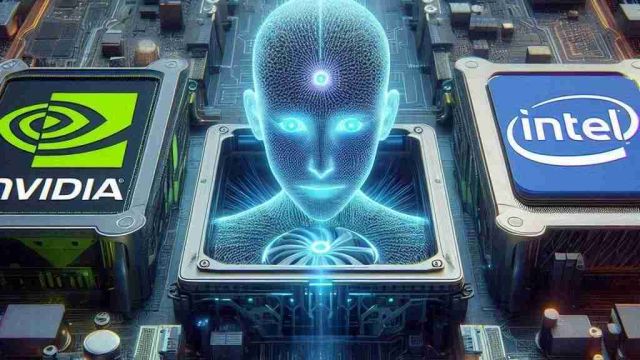

The 2025 AI Semiconductor Race: AMD, Nvidia, and Intel Strategies
The “AI Factory” boom has long been viewed through a narrow lens: Nvidia is winning, and everyone else is scrambling for leftovers. However, as we enter the first quarter of 2026, that singular narrative has fractured into a complex, high-stakes battlefield. We are witnessing “The Great Decoupling,” a period where the traditional boundaries between silicon rivals have blurred, and the sheer velocity of hardware innovation is beginning to outpace the software written to harness it.
For enterprises and investors, the relatable problem has shifted from securing allocation to managing obsolescence. We are in a world where hyperscalers like Alphabet, Amazon, Microsoft, and Meta are projected to spend nearly $700 billion on AI data centers this year alone. In this environment, hardware cycles move at a “relentless” pace, punctuated by surprising alliances and technical leaps such as 35x performance gains that suggest the market’s hierarchy is far from permanent.
1. The Death of Moore’s Law and the Rise of the Annual Cadence
The semiconductor industry’s historical two-year rhythm for major architectural shifts has been discarded. To keep pace with the exponential growth of frontier AI models, AMD has weaponized an annual product roadmap that forces a radical shift in data center economics.
The strategy is a drumbeat of rapid-fire releases: the Instinct MI325X in late 2024, the MI350 series in 2025, and the current rollout of the MI400 series in early 2026. This accelerated cadence shifts the burden of cost and rapid implementation onto data center providers, who must now refresh infrastructure almost yearly to avoid being left behind in the “tokens-per-dollar” race.
“With our updated annual cadence of products, we are relentless in our pace of innovation, providing the leadership capabilities and performance the AI industry and our customers expect to drive the next evolution of data center AI training and inference,” said Brad McCredie, corporate vice president, Data Center Accelerated Compute at AMD.
2. The 35x Leap: When “Incremental” Isn’t Enough
In the era of traditional CPU scaling, a 15% generational gain was a victory. The AI era has redefined the scale of success. The AMD Instinct MI350 series, built on a cutting-edge 3nm process technology and the CDNA 4 architecture, has delivered a staggering 35x generational increase in AI inference performance compared to the MI300 series.
This is not a theoretical benchmark. This leap was calculated using a 1.8-trillion parameter GPT Mixture of Experts (MoE) model, reflecting the market’s pivot from training-heavy workloads to inference-heavy production. By integrating native support for FP4 and FP6 AI datatypes, the MI350X addresses the fundamental economic shift of the industry: the need for massive throughput in real-time agentic execution. When performance jumps by 35x, hardware ceases to be a mere enabler and becomes a catalyst for entirely new, previously cost-prohibitive AI applications.
3. Weaponizing Openness: The Systems-Level Counter-Strike
While Nvidia maintains a formidable proprietary moat through CUDA and NVLink, AMD is betting that “open ecosystems will out-innovate closed systems over time.” This isn’t just philosophy; it is a tactical erosion of switching costs. To support this, AMD’s $4.9 billion acquisition of ZT Systems has transformed the company from a component vendor into a full-stack systems provider.
The centerpiece of this strategy is the Helios AI rack, a direct challenger to Nvidia’s GB200 NVL72. By championing industry-wide standards like UALink (Universal Accelerator Link) and the Ultra Ethernet Consortium (UEC), AMD is offering a reprieve from the “networking tax” exemplified by Nvidia’s 263% surge in networking revenue as it locks customers into its proprietary Spectrum-X stack.
AMD’s strategy now rests on three punchy pillars:
- Leadership Compute Engines: Integrated GPU (Instinct), CPU (EPYC), and Networking (Pensando) performance.
- Open Ecosystem: A matured ROCm 7 software stack that removes the friction of migrating away from CUDA.
- Full-Stack Solutions: The ability to deliver complete, rack-scale “plug-and-play” infrastructure through Helios.
4. “Lovers, Not Fighters”: The Strategic Irony of the Nvidia-Intel Alliance
In the most surprising geopolitical shift in silicon history, the late-2025 announcement of Nvidia’s $5 billion investment in Intel has reshaped the competitive landscape. This alliance is a classic case of “the enemy of my enemy is my partner.” Nvidia needed a credible x86 partner to counter AMD’s dominance in integrated “workstation-on-a-chip” components, specifically the AMD Ryzen AI Max Pro 395 (formerly Strix Halo).
Nvidia and Intel are now collaborating on an x86 RTX SOC, which fuses Nvidia’s GPU prowess with Intel’s CPU architecture. The irony is delicious: Intel recently cancelled its “Falcon Shores” chip specifically to pivot toward Jaguar Shores, a rack-scale solution designed to kill Nvidia’s Blackwell. Yet, Intel simultaneously accepted billions from Nvidia to build the very SOCs Nvidia needs to maintain its market grip.
“Intel spent 33 years trying to kill us,” Nvidia CEO Jensen Huang noted recently. “But we’re lovers, not fighters. Our partnership is because I can imagine a future for both of us where we could both win.”
5. The Eroding “Nvidia-Only” Perception
The consensus that high-end AI only runs on green silicon is dead. We are seeing a tectonic shift in industry credibility as the world’s largest AI developers diversify their hardware to ensure vendor flexibility.
Oracle Cloud has validated this shift with its zettascale deployment of over 131,000 AMD GPUs. Perhaps more damaging to the “Nvidia-only” moat is the collaboration between OpenAI’s Sam Altman and AMD on the upcoming MI450. Market intelligence suggests the MI450 may offer higher memory density and bandwidth than Nvidia’s upcoming Vera Rubin architecture. As the market matures toward “performance per watt” and “tokens-per-dollar” as primary metrics, OpenAI’s move to co-design with non-Nvidia partners signals that the era of single-source dominance is ending.
Conclusion: The Future is Distributed and Open
The AI chip wars have graduated from a race for raw FLOPs to a sophisticated battle for architectural flexibility and energy efficiency. As the largest developers Meta, Microsoft, and OpenAI actively co-design open alternatives to the CUDA ecosystem, the long-term viability of proprietary moats is being tested in real-time.
The Great Decoupling raises a provocative question for the next decade: In an era where the hardware cycle moves faster than software can be written, can any proprietary moat remain deep enough if the industry’s biggest spenders decide that openness is the only way to scale?





Leave a Reply