
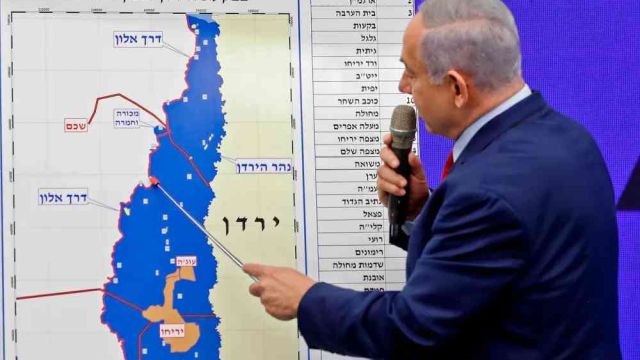

Legal and Political Perspectives on West Bank Annexation
While the international community’s attention is consumed by active combat zones and the immediate humanitarian fallout of 2024 and 2025, the administrative machinery of the Israeli government has been quietly dismantling the legal foundations of the West Bank. Distilled from the Negotiations Affairs Department (NAD) reports, the findings reveal that this is no longer a matter of “creeping annexation” it is a full-scale structural overhaul designed to be irreversible.
As Israeli Finance Minister Bezalel Smotrich declared in late 2024, explicitly telegraphing the current reality:

The following five developments represent a fundamental shift from military occupation to de jure civilian integration, effectively redrawing the map before the diplomatic window can close.
1. The “Civilian Deputy” Maneuver: Bypassing the Chain of Command
A pivotal moment in the governance of the West Bank occurred with the transfer of power from the military “Civil Administration” to the newly created “Settlement Administration” under the direct control of Bezalel Smotrich. To operationalize this, a civilian Hillel Roth was appointed as the Deputy Head of the Civil Administration.
This move creates a “legalization bypass” where a civilian political appointee holds the authority to issue direct orders to the military, effectively circumventing the Minister of Defense and the traditional military chain of command. Smotrich has been candid about the permanence of this shift: “The [settlements] administration is permanent, the division will solidify it… and the transfer of legal responsibilities is permanent… even if the government falls tomorrow.”
Critically, this authority now extends beyond Area C. Roth can now instruct the demolition of Palestinian structures within the “Agreed-Upon Reserve” in Area B 167,000 dunams of land (approximately 3% of the West Bank) previously governed under the Oslo and Wye frameworks. By placing this power in civilian hands, Israel has effectively expanded its administrative sovereignty into territory once earmarked for Palestinian civil control.
2. The “Land Settlement” Trap: Registration as Dispossession
In early 2026, the Israeli government approved a resolution to resume land title registration (the “Tabu”) in the West Bank for the first time since the 1967 occupation began. While proponents frame this as a neutral administrative move to correct historical registration freezes, the strategic intent is clear: the government has set a target of settling 15% of unregistered land approximately 290,000 dunams within five years.
The mechanism is essentially a legal trap. Palestinians must now prove ownership to a near-impossible standard of proof, often requiring documentation that has been lost or rendered invalid over decades of military rule. If these standards are not met, the land is automatically registered as “State Land.” Analysis from the NAD and Peace Now suggests this process could lead to the dispossession of Palestinians from up to 83% of Area C.
Furthermore, the cabinet is actively sabotaging Palestinian counter-efforts. Not only has it declared that Palestinian Authority (PA) land settlement activities carry no legal weight, but it has moved to block PA surveyors from entering lands and instructed the freezing or deduction of import tax revenues equal to the amount the PA invests in its own registration efforts.
3. The Outpost Explosion: Breaking the Record with State Funding
Settlement expansion has shattered historical records. Traditionally, fewer than seven illegal outposts were established annually. In 2024 alone, 43 new illegal outposts were established. This surge is coupled with a strategic shift toward “agricultural farms” or shepherding outposts. By using grazing rather than residential construction to seize land, these outposts now control roughly 7% of Area C.
The “Equal Citizenship Reform” has transitioned these outposts from wildcat settlements to permanent state-funded fixtures. The scale is illustrated by the staggering financial weight behind it: NIS 7 billion (approx. $1.9 billion) has been allocated for a five-year plan for settler roads, and NIS 1 billion has been added for settlement security needs in 2024-2025.
Adding to this territorial redrawing is the reversal of the 2005 Disengagement Act. Defense Minister Yoav Gallant’s cancellation of the order prohibiting Israelis from entering evacuated areas in the northern West Bank marks a formal return to territory abandoned two decades ago, creating the infrastructure for new settlements in areas once considered “cleared.”
4. The Jerusalem “Triangle”: The Physical Severing of Contiguity
A strategic “triangular” settlement plan is reaching its point of no return around East Jerusalem. This expansion is designed to physically and permanently isolate the city from the rest of the West Bank. The “triangle” is formed by three major axes:
- North: The Atarot plan, involving 9,000 housing units, to sever East Jerusalem from Ramallah.
- East: The E1 plan (3,426 units) and Ma’ale Adumim expansion to isolate the city from the Jordan Valley.
- South: The Givat Hamatos (4,700 units) and Har Homa axis to separate East Jerusalem from Bethlehem.
This is not merely a housing project; it is an “infrastructure glue.” The triangle is linked by an elaborate system of “ring roads” and tunnels that ensure absolute territorial contiguity for Israel while leaving Palestinian neighborhoods as disconnected enclaves. This “triangle” effectively eliminates the last available space for Palestinian socio-economic growth in their intended capital.
5. The Legal Paradox: Domestic Peaks vs. Global Rulings
There is a widening chasm between international law and domestic Israeli administrative policy. In July 2024, the International Court of Justice (ICJ) issued a landmark advisory opinion ruling that the West Bank, East Jerusalem, and Gaza constitute a “single territorial unit” under illegal occupation, demanding the evacuation of all settlers. This was followed by a September 2024 UN General Assembly resolution setting a 12-month deadline for Israel to end its “unlawful presence.”
In direct defiance, domestic “State Land” declarations have hit a record peak. In 2024, the government declared 24,193 dunams as state land the highest amount since the 1993 Oslo Accords. Most of this (20,859 dunams) is concentrated in the Jordan Valley, effectively seizing the agricultural heartland of a future Palestinian state. This administrative surge creates a paradox where the international legal order demands a total withdrawal while the domestic bureaucratic machine accelerates permanent integration.
Conclusion: The Death of the “Guardrails”
The shifts implemented between 2024 and 2026 are not merely political posturing; they are the construction of a new de jure reality. By transferring authority from military commanders to civilian deputies like Hillel Roth, the Israeli government has removed the administrative “guardrails” that theoretically maintained the temporary nature of the occupation.
As the source context warns, these moves are designed to ensure that any future Palestinian state is “unviable” a series of disconnected cantons perpetually dependent on Israel for movement, resources, and legal recognition. With the administrative foundations of annexation now firmly laid, we must ask: If the machinery of the occupation has been fully integrated into the civilian state, what remains of the diplomatic path to peace?




Leave a Reply