

Peru at a Breaking Point: Ten Years of Political Turmoil
Introduction: The Carousel of Power
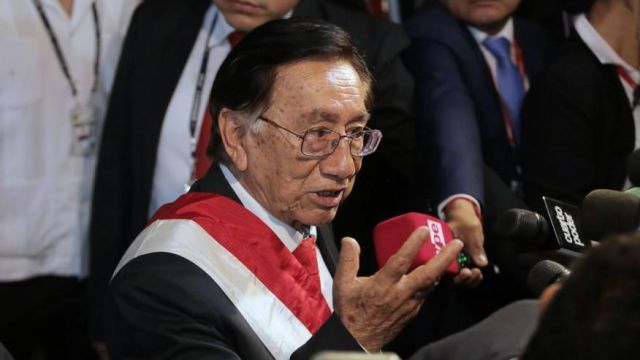
Since 2016, the Peruvian presidency has ceased to be a symbol of national stability, having been cannibalized by a cycle of perpetual impeachment and “moral incapacity” vacancies. The executive office has devolved into a grotesque game of musical chairs where leaders are discarded with the same speed as the headlines that indict them. It is within this institutional decay that the improbable has become the inevitable: the rise of José María Balcázar. At 83 years old, this independent congressman has ascended to the highest office in the land, not through the popular will of a sovereign electorate, but through the desperate machinations of a hollowed-out parliament. His presidency is the ultimate symptom of a republic that has traded its democratic soul for the survival of its political class.

1. The Ultimate “Accidental” Ascension
The timeline of February 17–18, 2026, will be remembered as the 24 hours that proved the Peruvian presidency is now a prize won through parliamentary maneuvering rather than electoral merit. On February 17, President José Jerí was censured and removed, leaving a leadership vacuum that the legislature scrambled to fill.
By the following morning, Balcázar—a man who had publicly declared he was not seeking re-election in the 2026 cycle—was suddenly the man of the hour. Far from a spontaneous consensus, his rise was a calculated move by the Free Peru (Perú Libre) caucus. Nominated as their pawn to check the influence of the right-wing opposition, Balcázar secured a 60-vote victory over Maricarmen Alva. In a single day, an octogenarian lawyer with no national mandate became the 66th President of Peru, assuming power not because the people chose him, but because he was the most convenient tool for a fractured Congress.
2. The Judge Deemed Unfit to Judge
The most bitter irony of the Balcázar presidency is his background in the very judiciary he now oversees. While he once sat as a provisional supreme member of the Supreme Court, his judicial legacy is one of ignominy. In 2011, the National Council of the Judiciary (CNM) officially stripped him of his robes, declining to ratify him for two damning reasons: a troubling disciplinary record and “poor legal reasoning” demonstrated during his interview.
To understand the stakes, one must look at the specific legal disasters Balcázar facilitated. Most notoriously, he presided over the July 2005 release of the Wolfenson brothers, owners of the tabloids La Razón and El Chino and known associates of the disgraced spymaster Vladimiro Montesinos. This decision was based on a law later deemed unconstitutional and involved a flagrant violation of the legal principle of res judicata—the finality of a matter already judged. A man officially labeled by his peers as legally deficient and historically soft on corruption is now the ultimate arbiter of the nation’s laws.
3. A Legacy of Personal Bank Accounts and “Illicit Appropriation”
Balcázar’s financial history is equally fraught. During his tenure as Dean of the Illustrious Bar Association of Lambayeque (ICAL) from 2019 to 2020, he was accused of treating the organization’s coffers as a personal piggy bank. Allegations surfaced that he directed approximately two million Peruvian soles (roughly $600,000 USD) of the association’s income into his personal accounts.
The professional repercussions were swift but apparently no barrier to higher office. He was expelled from the Bar Association in 2022, a decision that was definitively ratified in December 2024, just over a year before he reached the presidency. Even as he was sworn in, Balcázar remained under the cloud of ongoing “illicit appropriation” proceedings. His ascension illustrates the endemic corruption that has become a prerequisite for survival in the current Peruvian political climate.
4. Shocking Views on Child Marriage and Moral Incapacity
In a nation struggling with human rights concerns, Balcázar’s legislative record on social issues is nothing short of medieval. In 2023, while debating the criminalization of child marriage, he offered a defense that sent shockwaves through the international community:
“Without violence, such marriages would benefit a young girl’s mental development.”
This was not a solitary lapse in judgment. Balcázar also spoke favorably about sexual relationships between students and teachers, effectively arguing against modern legal protections for minors. These views, often cited as evidence of “moral incapacity,” signify a dangerous retreat from democratic norms. In a healthy democracy, such statements would lead to political exile; in Peru’s current state of democratic backsliding, they were merely a footnote in his climb to the Government Palace.
5. A Symptom of a “Failed Democracy”
Balcázar’s presidency is the definitive evidence for analysts who now label Peru an “emerging authoritarianism” or a “failed democracy.” He fits perfectly into a lineage of leadership where investigative files are more common than policy achievements. He joins a list of nearly every living former president—Toledo, Humala, Kuczynski, Vizcarra, and Castillo—who has been investigated or convicted for corruption.
The most recent “smoking gun” involves his ties to the Patricia Benavides scandal within the Public Ministry. Reports emerged that Balcázar provided Benavides’ advisors with his daughter-in-law’s curriculum vitae; she was subsequently hired by the Prosecutor’s Office. In exchange, Balcázar aligned with far-right elements to support the dissolution of the National Board of Justice (JNJ), the body investigating Benavides for heading a criminal organization. This blatant nepotism and “tit-for-tat” politics are the engines that keep the current regime running.

Conclusion: What remains of the Republic?
The rise of José María Balcázar marks a grim milestone in the Peruvian political crisis. The electorate is no longer merely cynical; they are exhausted. Confidence in established parties has evaporated as the presidency has been reduced to a tool for parliamentary survival and immunity.
As we look at an 83-year-old leader with a “poor” legal record, a history of financial misconduct, and shocking views on human rights, we must ask: Can a presidency born of technicalities and backroom deals ever achieve true social legitimacy? The “accidental” rise of Balcázar is not a resolution to the crisis—it is the final confirmation that the Republic is in a state of terminal institutional decay.



Leave a Reply