
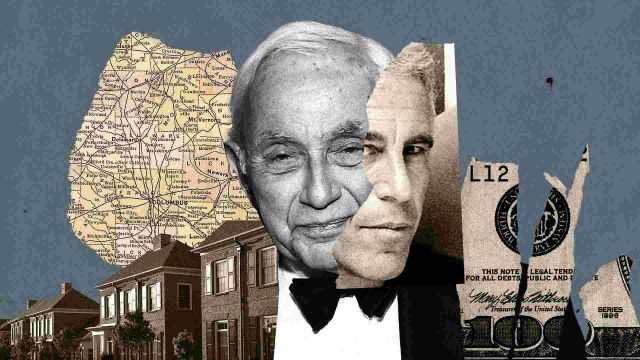

The Ohio Ghost Town: Why the GOP Fled the Les Wexner Deposition
In the landscape of political theater, few topics generate as much digital heat as the Jeffrey Epstein investigation. Yet, when the opportunity finally arrived to question one of Epstein’s most significant financial lifelines, the room was defined by a haunting silence.
The deposition of billionaire retail mogul Les Wexner was supposed to be a cornerstone of the House Oversight Committee’s pursuit of “justice for the children.” Instead, it became an exercise in selective amnesia. While representatives routinely use social media to perform outrage, their actual attendance at the proceedings in Ohio suggested a far more comfortable reality: when the subpoenas are served, the “truth-seekers” evaporate.
The central conflict is no longer just about what Epstein did; it is about why the very people tasked with oversight are currently nowhere to be found.
The Absolute GOP “No-Show”
The news, broken by Representative Dave Min, is a damning indictment of the current political climate. Not a single Republican member of the House Oversight Committee attended the Les Wexner deposition.
The irony of the location cannot be overstated. The proceedings took place in Ohio the home state of Jim Jordan, one of the committee’s most vocal and powerful members. That Jordan would skip a high-stakes deposition in his own backyard, involving a primary associate of Jeffrey Epstein, signals a profound shift from oversight to avoidance.
Notable absentees who have built entire digital brands on the promise of Epstein-related accountability include:
* James Comer (Chair)
* Jim Jordan
* Nancy Mace
* Lauren Boebert
The absence of Mace and Boebert is particularly jarring given their frequent public demands for transparency. As Rep. Dave Min summarized: “They seem to literally don’t care about Epstein and his co-conspirators.”
The Curious Silence of Federal Agencies
Perhaps the most startling revelation from the room came from Wexner himself. Under oath, Wexner claimed he has not been contacted by the FBI or the Department of Justice (DOJ) regarding the Epstein investigation.
This lack of outreach is a staggering procedural failure. Wexner did not merely “know” Epstein; he granted him full power of attorney and provided the financial foundation upon which Epstein’s lifestyle was built.
In any standard human trafficking inquiry, a witness with this level of legal and financial proximity would be a primary target for federal investigators. The total silence from the DOJ and FBI suggests a disconnect between the public’s expectation of a rigorous investigation and a federal reality of institutional stagnation.
The Shadow of the “Mega Group” and Intelligence Ties
To understand the lack of federal aggression, one must look at the historical “Mega Group” a circle of billionaire philanthropists of which Wexner is a prominent member.
While the group presents as a charitable collective, its name carries the weight of the 1997 “MEGA” affair. At that time, the National Security Agency (NSA) intercepted conversations between Israeli intelligence officers discussing a high-level mole within the U.S. government, code-named “Mega.”
The stakes of this intelligence network were highlighted in 1999 when reports emerged that Mossad had allegedly intercepted private, sexually explicit phone calls between President Bill Clinton and Monica Lewinsky. The objective, according to intelligence analysts, was to leverage the recordings to prevent a deeper federal investigation into the “Mega” mole. This historical context provides a chilling framework for why certain investigations into the “Epstein class” appear to hit an invisible wall whenever they approach the intersection of intelligence and high finance.
State and International Momentum vs. Federal Stagnation
As Washington D.C. remains frozen, the momentum for accountability has shifted to state and international jurisdictions. The contrast between the Congressional “no-show” and external action reveals where the actual investigation is living:
* New Mexico’s Truth Commission: State lawmakers unanimously approved a $2.5 million “truth commission” equipped with subpoena power to investigate crimes committed at Epstein’s Zorro Ranch.
* France’s Elite Prosecutor Team: An elite team of prosecutors has been assembled in France to meticulously analyze the Epstein files and target French nationals involved in the network.
* Active Police Raids: Recent criminal raids in France underscore an active pursuit of leads that American federal agencies have seemingly bypassed.
The “Cawthorn Warning” and the Pokemon Metaphor
The decision to skip the Wexner deposition may be a matter of professional survival. Within the halls of Congress, the case of former Representative Madison Cawthorn serves as a grim cautionary tale. After Cawthorn publicly alleged that colleagues were engaging in “cocaine orgy parties,” he was met with swift political execution and leaked personal videos.
This environment creates a powerful incentive for silence. As some researchers have noted, the “Epstein class” appears to collect politicians “like Pokemon cards” assets to be held, traded, and utilized. In this system, participation in a deposition that could implicate donors or colleagues is not just a risk; it is a career-ending move. Silence is not an oversight; it is an act of complicity designed to protect the collective.
The Accountability Gap
The landscape of the Epstein investigation is currently defined by what is missing. Rep. Nancy Mace herself has claimed that crucial audio and video evidence from Epstein’s properties are “missing” from the official files yet she was among those who failed to show up to question Wexner.
We are left with a stark divide between political performance and legislative action. When the representatives who scream the loudest on social media refuse to enter the room where the questions are finally being asked, the message is clear.
If those in power won’t even show up to the room where the truth is recorded, who is actually left to provide the answers?

Leave a Reply