
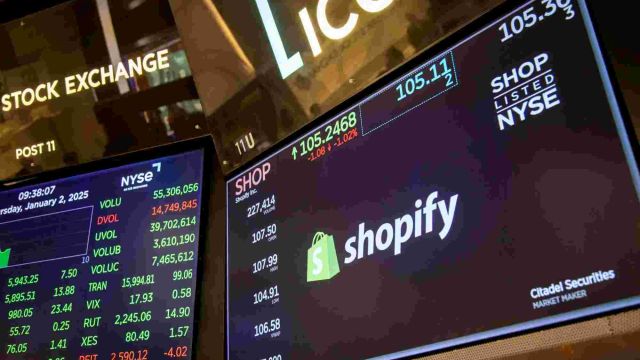

Shopify Got Battered by the Software Panic. Wall Street Says to Buy.
The Great Disconnect
The financial markets are currently witnessing a startling paradox. In mid-February 2026, Shopify reported one of the most fundamentally sound quarters in its history, only to be met with a punishing “Multiple Compression” that has left many investors scratching their heads. Despite delivering a massive 31% revenue growth in the fourth quarter of 2025—reaching $3.7 billion—the stock has been swept into the general “SaaS-Pocalypse,” resulting in a 26% year-to-date decline.

The disconnect reached a fever pitch during recent trading sessions. Following the earnings release, shares opened 8% higher on the back of a significant revenue beat. However, by midday, the stock suffered a sharp 12% reversal. The catalyst? A knee-jerk reaction to Q1 2026 free cash flow (FCF) guidance, which management projected in the low-to-mid teens. While short-sighted traders fled on the margin dip, seasoned strategists recognized it as a temporary tax-related artifact masking a business that is quite literally firing on all cylinders. The question for the savvy investor is clear: why sell the infrastructure of the future because of a seasonal margin fluctuation?
Takeaway 1: The Valuation Gap vs. The Sticker Price
For those looking to enter a category leader, the recent software panic has compressed Shopify’s valuation to a multi-year low. According to TD Cowen analyst John Shao, the Enterprise Value-to-Sales (EV/Sales) ratio has dropped to 9.9x. This is significantly below the one-, two-, and three-year averages of 13.4x, 12.1x, and 11.5x, respectively.
However, a balanced analysis requires looking at the “sticker price.” Shopify still carries a steep P/E ratio of 85, which explains the market’s current hesitation during a period of high volatility and a high beta (2.82). Yet, when we adjust for a five-year revenue CAGR of 41%, that P/E looks less like a premium and more like a bargain for secular growth.
“The shares now trade at 9.9x next-twelve-month EV/Sales… [this creates] an attractive entry point for investors to own the de facto modern-day eCommerce infrastructure with durable, high growth,” notes John Shao.

Takeaway 2: From “Store Builder” to Global Cultural Infrastructure
Shopify is no longer just the “go-to for startups.” It has evolved into the mission-critical technical architecture for the world’s largest brands. In Q4 2025, Shopify’s Gross Merchandise Volume (GMV) hit $124 billion, a 31% increase. This scale is supported by technical specifications that legacy systems simply cannot match: a 99.9% uptime and response times under 50ms.
This reliability is why the platform is now the “cultural infrastructure” for giants like Tesla, LVMH, Nestlé, Aldo, BarkBox, SKIMS, and Supreme. By powering 12% of all U.S. e-commerce, Shopify has moved from being a vendor to an essential utility, making it exceptionally resilient to market seasonality.
Takeaway 3: Agentic Commerce and the “Walled Garden Killer”
The most strategic pivot in the Shopify story is the transition to “Agentic Commerce” via the Universal Commerce Protocol (UCP). Developed in partnership with Google, UCP is a structural “Walled Garden Killer.” While Amazon’s model relies on keeping data and customers trapped within its own ecosystem, UCP allows Shopify’s merchants to be discovered and purchased by AI agents—like Gemini or Copilot—anywhere on the open web.
This isn’t a solo mission. UCP has already been endorsed by a coalition including Wayfair, Etsy, Walmart, and Target. With an ecosystem of over 21,000 apps, Shopify is ensuring that as we move from intent-based search (typing in a bar) to agent-driven fulfillment, its merchants remain the primary source of truth for AI buyers. President Harley Finkelstein noted that AI search orders have already increased 15-fold since January 2025.
“2025 was Shopify at full throttle—driving compounding growth, while laying the rails for the new era of AI commerce,” said Finkelstein.
Takeaway 4: The $2 Billion “Capital Allocation” Shield
In a decisive move for its capital allocation strategy, Shopify’s Board authorized a $2 billion share repurchase program. This acts as a “vulnerability shield” against the current market volatility. The financial rigor here is notable: the $2 billion buyback is perfectly calibrated to the company’s full-year 2025 free cash flow of $2 billion.
With zero debt on the balance sheet and ten consecutive quarters of double-digit FCF margins, the buyback signals management’s absolute conviction that the stock is mispriced. Notably, the repurchase is being executed via disciplined algorithmic trading instructions to ensure maximum efficiency.
“We are launching this share repurchase program from a position of financial and operating strength… prioritizing growth while remaining disciplined, flexible, and focused on long-term value,” said CFO Jeff Hoffmeister.
Takeaway 5: The B2B and POS “Quiet Revolution”
While the headlines focus on online storefronts, Shopify is quietly dominating the physical and wholesale worlds.
* B2B Momentum: This segment grew 96% in 2025, with Q4 alone seeing 84% growth. It is no longer a small experiment; it is a displacement of legacy enterprise systems.
* Offline Standard: POS revenue reached $748 million in 2025, and hardware is now available in 18 countries.
* Payments Penetration: Shopify Payments has reached 68% penetration, while Shop Pay has processed a staggering $324 billion in cumulative GMV since its 2017 inception.

Conclusion: The Year of the Builders
As we navigate 2026, the gap between Shopify’s price and its performance is a textbook case of market noise vs. fundamental signal. While the “SaaS-Pocalypse” has battered the shares, the company’s internal momentum remains at full throttle.
Shopify has spent the last year building the financial and technical rails for the next decade of commerce. As shopping shifts from human browsing to autonomous AI discovery, the ultimate question for the market is this: If AI is the buyer, who owns the catalog? Thanks to UCP and an infrastructure-first approach, Shopify is positioned to be the primary gatekeeper of the next generation of global trade.




Leave a Reply