
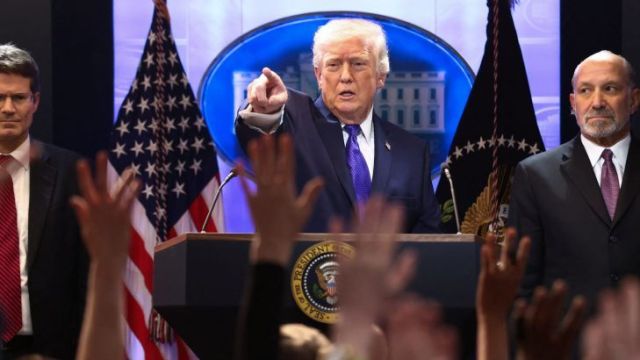
Global Trade and the 2026 Trump Tariff Crisis
The transition from Friday, February 20, 2026, to Tuesday morning will be remembered as the weekend the era of predictable global trade officially fractured. On Friday, the U.S. Supreme Court delivered a stunning 6-3 ruling in Learning Resources, Inc. v. Trump, invalidating the administration’s use of the International Emergency Economic Powers Act (IEEPA) to impose broad “reciprocal” tariffs. The ruling effectively vaporized three-quarters of the administration’s tariff revenue overnight, creating a fiscal vacuum that many expected to signal a return to trade normalcy.
Instead, the White House executed a breathtaking pivot to Section 122 of the Trade Act of 1974 a rarely used “balance-of-payments” authority. Within 48 hours, a 10% global surcharge was announced, then rapidly escalated to the 15% statutory maximum. By 12:00 am EST on Tuesday, the theoretical became tangible: U.S. Customs and Border Protection deactivated the now-defunct IEEPA tariff codes, sparking a “Customs Chaos” that has paralyzed ports and sent the global trading order into a deep freeze. We have moved beyond mere protectionism; we are witnessing the weaponization of the American consumer base.
1. The “Stacking” Trap: When 15% Is Actually 30%
The most immediate source of the current “Customs Chaos” is a profound legal fog regarding how the new duties interact with existing trade law. While some early market reports suggested that the Section 122 tariffs would not “stack” on top of previous duties, the reality on the ground for firms importing from the EU and UK suggests a different story.
Because Section 122 acts as a global surcharge to address balance-of-payments deficits, it is being applied as a price floor on top of “most-favored-nation” (MFN) rates. For European exporters, this creates a cumulative duty environment as high as 30%. As Bernd Lange, Chair of the European Parliament’s Trade Committee, noted, this creates “pure customs chaos,” as the legal ambiguity of the new U.S. policy makes it effectively impossible for firms to calculate landed costs or honor long-term supply contracts.
2. The Inverted Leaderboard: Why China and Brazil are “Winning”
In a twist of geopolitical irony, the very countries targeted by President Trump’s most aggressive rhetoric have emerged as the primary beneficiaries of this legal reboot. The SCOTUS ruling didn’t just strike down reciprocal duties; it also invalidated specific social-policy levies, such as the fentanyl-related tariffs that had heavily burdened Canada and Mexico.
This “reboot” has created a new map of winners and losers. By shifting to a flat 15% baseline from a pre-ruling environment of punitive emergency rates, several “adversaries” are seeing effective rate reductions:
- Brazil: Down 10.0 percentage points (to a new effective rate of 2.4%)
- Mainland China: Down 6.6 percentage points (to 14.3%)
- Mexico: Down 1.7 percentage points (to 3.1%)
Conversely, traditional allies like the UK and the EU have been unceremoniously shoved to the bottom of the leaderboard. Because these nations had previously negotiated “special” lower rates or exemptions, the new 15% global floor has erased their comparative advantage, forcing their effective rates upward and stripping them of their “most-favored” status in practice.
3. The “Apple Exception”: How 15% Became a Safe Harbor
The market’s reaction to this volatility has been sharply bifurcated, creating a two-tier corporate reality. While the Dow Jones tumbled 1.6% on the news, Apple (NASDAQ: AAPL) saw its shares gain 4%. This is the “Safe Harbor” effect: for tech giants sitting on massive cash reserves, a predictable 15% surcharge even one costing an estimated $3.3 billion annually is vastly preferable to the 50%+ “reciprocal” duties threatened under the previous regime.
However, what is a safe harbor for Big Tech is a graveyard for sectors with thinner margins. The “Automotive and Luxury Sector Meltdown” is well underway; Toyota has warned of a $9.5 billion impact, while LVMH saw shares slump 8% as its Wines & Spirits division faced a 25% profit drop. In this new era, companies that cannot “buy” their way into stability through massive domestic investment pledges are finding themselves underwater.
4. The Trillion-Dollar Illusion: The Hidden Costs of Retaliation
A persistent myth suggests that higher tariffs are a simple windfall for the Treasury. Data from the Peterson Institute for International Economics (PIIE) dismantles this, revealing a “trillion-dollar illusion.” The modeling suggests a Laffer Curve reality: higher rates eventually shrink the tax base so significantly that net revenue collapses.
| Metric (Over 10 Years) | 15% Surcharge (No Retaliation) | 15% Surcharge (With Retaliation) | 20% Surcharge (With Retaliation) |
| Gross Revenue | $3.9 Trillion | $2.9 Trillion | $2.7 Trillion |
| Net Revenue Gain* | $3.2 Trillion | $1.5 Trillion | $791 Billion |
| *After accounting for economic damage, lower production, and decreased real wages. |
The 20% scenario yields the lowest net gain precisely because the resulting trade war and economic slowdown erode corporate and household tax payments so aggressively.
5. The “150-Day Ticking Clock”: A New Era of Trade Volatility
The most potent aspect of Section 122 is its built-in expiration date. By law, the surcharge expires after 150 days (July 24, 2026), unless extended by Congress. Far from a sunset clause, this is a diplomatic gun to the head. The administration is using this window as a tool of “tariff blackmail” to force allies back to the table under duress.
The fallout has been immediate and destructive:
- The EU: Has frozen parliamentary work on the “Turnberry Agreement,” which was intended to cap transatlantic duties.
- Japan: Stalled the ratification of a $550 billion investment pledge, citing “unforeseen administrative volatility.”
- South Korea: Facing threats of 25% automotive duties if previous spending commitments are not honored immediately.
Conclusion: The End of Post-WWII Liberalized Trade
We are witnessing a moment comparable to the “Nixon Shock” of 1971, but with a level of supply-chain complexity that 20th-century policymakers could never have imagined. The “Customs Chaos” of February 2026 represents a permanent shift toward economic nationalism, where market access is no longer a shared goal but a blunt instrument of national power.
The fundamental question for the global economy is no longer about the specific rate of a tariff, but the permanence of the volatility. Can the concept of “Just-in-Time” manufacturing survive in a “Just-by-Executive-Order” world? As the 150-day clock ticks toward July, predictability the very lifeblood of global trade remains the most significant casualty of this new war.




Leave a Reply