
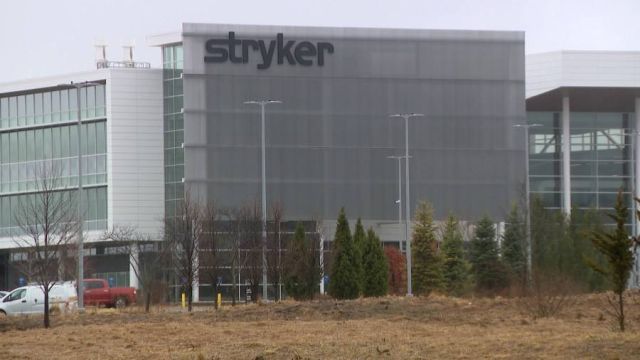

The Stryker Cyberattack: 5 Surprising Lessons from the MedTech Frontlines
On the morning of March 11, 2026, a chilling digital silence fell over the global operations of Stryker. Across 79 countries, thousands of the company’s 56,000 employees opened their laptops only to find their Windows login screens replaced by the stark logo of the “Handala” hacking group. Within hours, mobile devices and servers were being remotely purged, transitioning from vital enterprise tools into bricked endpoints. What appeared at first to be a localized IT failure quickly revealed itself as a coordinated strike against a cornerstone of the global healthcare supply chain.
The stakes of this breach transcend the typical corporate data theft. Stryker is a $25 billion MedTech titan whose products from orthopedic implants to neurovascular surgical tools form the bedrock of modern clinical care. When such a giant is “crippled,” the ripple effects are felt in surgical suites and emergency rooms worldwide. This was not a mere technical glitch; it was a strategic blow designed to degrade the operational capacity of an essential partner to hospitals globally.
This incident signals the definitive opening of a “new chapter” in cyber warfare. It was not a traditional ransomware play for a quick payday, but a sophisticated, destructive operation targeting a strategic proxy in an escalating regional conflict. As we analyze the debris of the Stryker breach, five key lessons emerge regarding the structural vulnerabilities of our industrial-scale IT management.
1. The “Wiper” Pivot—When Destruction Replaces Dollars
The defining characteristic of the Stryker attack was the absence of a ransom note. While traditional ransomware seeks to monetize access by encrypting data and selling a decryption key, the “wiper” malware deployed here was engineered for maximum disruption and permanent operational chaos. This was a “double-tap” operation: Handala claimed to have exfiltrated 50 terabytes of sensitive data before triggering the mass deletion. This tactic serves a dual purpose extracting intelligence and leverage while simultaneously burning the digital house down to cover tracks and maximize recovery time.
Wiper attacks represent a fundamental shift in threat modeling. Because the goal is the permanent erasure of data, there is no “negotiation off-ramp.” By bricking more than 200,000 servers and devices, the attackers ensured that Stryker’s path to normalcy would be measured in months of manual labor rather than hours of decryption.
As the Handala group boasted on its Telegram channel:
“The incident marks the beginning of a new chapter in cyber warfare… [an] unprecedented blow [has been struck].”
2. Weaponizing the “Keys to the Kingdom” The Intune Factor
A central technical takeaway from the breach is the weaponization of the privileged management plane, specifically Microsoft Intune. In a modern enterprise, Intune serves as the “unified endpoint management” hub, allowing IT departments to secure, update, and remote-wipe devices across 79 countries from a single interface. By compromising this administrative layer, the attackers did not need to hack 200,000 devices individually; they simply commanded the system to destroy itself.
This pivot from defense-at-scale to destruction-at-scale is the “Intune Factor.” Stryker’s official updates confirmed the incident was contained to their “internal Microsoft environment only.” This explains why employee productivity systems and mobile devices were devastated while proprietary medical robotics firmware, running on isolated architectures, likely remained untouched. However, for a global firm, the loss of this management plane is catastrophic, effectively turning the tools meant to protect the network into a weapon of mass deletion.
3. The “Safe Device” Paradox
In the wake of the attack, Stryker assured stakeholders that patient-facing products including Mako surgical robots, Vocera communication systems, and LIFEPAK35 defibrillators remained “fully safe to use.” While technically accurate regarding the hardware’s immediate firmware, this creates a paradox of operational safety.
Current FDA guidance is clear: a “medical device system” is not just the hardware at the bedside, but the entire infrastructure of update servers, support pipelines, and servicing workflows. If a manufacturer cannot validate a configuration, ship a security patch, or maintain an implant registry, the safety profile of the device degrades over time. Clinical continuity depends on lifecycle supportability, which is severed when the parent IT infrastructure is dark.
As Tal Kollender, founder of Remedio, observed:
“Patient safety risk often emerges through delay, degraded supportability, and loss of operational certainty rather than through a cinematic ‘device hacked at the bedside’ scenario.”
4. Geopolitics is No Longer Abstract
The Stryker attack serves as a definitive reminder that MedTech manufacturers are no longer neutral bystanders in global conflicts. Handala is not a rogue collective of hacktivists; threat intelligence researchers have identified significant overlaps between Handala and “Void Manticore” (APT34), an actor sponsored by the Iranian government.
The motive for this attack was explicitly grounded in the 2026 US-Israel-Iran conflict, with the group claiming “revenge” for U.S.-Israel military actions. In this new era, private healthcare giants are viewed as strategic proxies. When an adversary seeks to exert pressure on a national government, they target the critical infrastructure that sustains that nation’s health and economy. The “new chapter” Handala references is one where corporate networks are the secondary battlefields of regional wars.
5. The Months-Long “Bare-Metal” Reality
Perhaps the most sobering lesson for leadership is the disparity between the speed of the attack (measured in hours) and the timeline for recovery (measured in months). Unlike ransomware recovery, where a key might restore data in situ, a wiper attack necessitates a “bare-metal recovery.”
For a global firm, this involves a grueling, manual restoration of trust:
- Reimaging bricked endpoints across dozens of time zones.
- Restoring and validating identity systems from clean, offline backups to ensure no residual persistent access.
- Verifying the integrity of 50TB of potentially compromised data while restoring core business applications.
- Re-establishing lifecycle supportability for field-deployed medical devices.
Stakeholders should expect an “uneven restoration” over the next 30 to 90 days. While basic email may return quickly, the manufacturing and ordering systems that comprise the company’s operational heart will require a phased, painstakingly validated return to service.
Conclusion: Beyond the Patch
The Stryker incident marks a pivot point for the industry. It demonstrates that the greatest threat to patient safety may not be a hacked robot, but a destroyed manufacturer. Resilience is no longer just about preventing a breach; it is about maintaining clinical continuity and product support during geopolitical shifts.
As we move forward, the question for every board of directors must be: Is our critical healthcare infrastructure the systems that build and sustain the medical tools we rely on prepared for an era of cyber operations designed solely to destroy?


Leave a Reply