
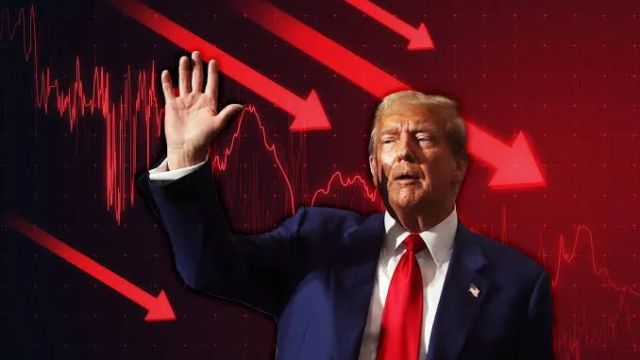

The CAPE of Despair? Navigating the 2026 “Detox” and the $700 Billion AI Hardware Sinkhole
As President Donald Trump navigates the second year of his non-consecutive second term, the buoyant optimism of his first-term market performance characterized by a 57% Dow gain and a 142% surge in the Nasdaq has been replaced by a regime of “unprecedented uncertainty.” The relative calm of late 2025 was shattered by the early April 2025 “one-week swoon,” a volatility event that served as a grim reminder of the five-week COVID-19 crash. Today, Wall Street is grappling with a fundamental question: Is the current market turbulence a symptom of policy-induced chaos, or a “wild chess move” designed to force a structural reset of the global financial system?
The administration has framed this period as a necessary “detox” for an economy addicted to easy money and foreign manufacturing. However, as major indices flirt with bear market territory and volatility remains the only constant, the line between a calculated correction and a systemic gamble has blurred. To understand the 2026 landscape, one must look past the headlines and into the volatile mechanics of trade salvos, valuation red zones, and a looming war for Federal Reserve independence.
Navigating the 2026 “Detox”
The economic friction point arrived on “Liberation Day” April 2, 2025 when the administration unleashed a tariff salvo that pushed the US effective import-weighted tariff rate to 25.5%, a level not seen since the McKinley era of the 1890s. While a universal minimum tariff of 10% was established, the weighted average is the metric suffocating corporate planning.
The strategy is “reciprocal” in name but aggressive in practice. While a 90-day pause was granted to over 50 countries currently under negotiation leaving them with a +10 percentage point (pps) hike China was excluded from the reprieve. Following a +125pps hike, the effective tariff rate on Chinese imports now stands at a staggering 130%. In contrast, the European Union faces a 9% rate. The resultant “fog of war” is not merely rhetorical; it is a financial headwind. Between fluctuating rates and the legal volatility of a $175 billion refund requirement following Supreme Court challenges, the cost of capital is being eclipsed by the cost of uncertainty.
“Like a fog of war, it is unclear what the final tariff landscape will look like, but the cost of uncertainty is high.” – Allianz Research
The 25-Year Red Alert: Shiller P/E Hits 40
In January 2026, the Shiller Price-to-Earnings (CAPE) ratio which smooths valuations by using ten years of inflation-adjusted earnings hit 40. This is the second-priciest market in history, surpassed only by the peak of the dot-com bubble. For macro-strategists, this is not a sign of strength, but a “Red Alert.”
Historical precedent is merciless: in every previous instance where the Shiller P/E topped 30, indices eventually shed between 20% and 89% of their value. While proponents of the “AI Exceptionalism” theory argue that productivity gains justify these multiples, the historical floor is far lower. Crucially, no bear market in US history has ended with a Shiller P/E higher than 27. If this threshold holds, the S&P 500 may need to shed at least a third of its value before a sustainable bottom is found.
The $700 Billion AI Hardware Sinkhole
The primary driver of these historically high valuations is the massive capital expenditure by the “hyperscalers.” Companies like Amazon and Oracle are projected to pour a combined $700 billion into AI data center hardware. However, this investment masks a “depreciation drag” that is beginning to bleed into reported earnings.
As these hyperscalers purchase hardware at an unprecedented scale, the equipment begins to age immediately. The resulting non-cash depreciation expense creates a long-term drain on net income, even if revenue continues to climb. The market is already sniffing out the decay; Amazon and Oracle shares have retreated 7% and 24%, respectively, year-to-date. With consumer-facing AI giants like OpenAI projected to lose $14 billion this year, the risk is that the $700 billion “hardware sinkhole” will eventually be exposed as a massive misallocation of capital.
The “Wild Chess Move”: A Purposeful Crash?
A provocative theory has taken hold within the administration, originating from the “AmericanPapaBear” parody account on X but gaining strategic weight through official endorsement. The theory suggests that a 20% market crash is a “wild chess move” intended to achieve three tactical objectives:
- Monetary Capitulation: A sharp downturn forces cash into the safety of Treasuries, theoretically compelling the Federal Reserve to slash rates.
- The “Mar-a-Lago Accord”: This concept involves devaluing the dollar through “unorthodox channels,” such as imposing “user fees” on interest payments to foreign Treasury holders or swapping current debt for “century bonds” to manage interest expense.
- The Middle Class Reset: Proponents argue that crashing the valuations of the 8% of Americans who own 94% of all stocks is a necessary sacrifice to lower grocery prices specifically the cost of eggs and force a “reshoring” of industrial capacity.
The War for Federal Reserve Independence
The Federal Open Market Committee (FOMC) is currently a “mess” of historic proportions. There has been at least one dissent in each of the last five meetings, and the “dot plot” has become a source of ridicule, with members like Stephen Miran signaling contradictory paths for rate hikes and cuts.
This internal rift coincides with the impending end of Jerome Powell’s term in May 2026. The nomination of Kevin Warsh has introduced a hawkish volatility to the outlook. Warsh has expressed a desire to aggressively deleverage the Fed’s $6.6 trillion balance sheet. If Warsh moves to sell off Treasury bonds and mortgage-backed securities, he could inadvertently spike long-term yields, crushing the very recovery the administration seeks to engineer. A loss of Fed credibility at this juncture would trigger an “elevator-down move” for Wall Street.
Resilience in the Fog
The Allianz baseline for 2025-2026 is a global GDP slump to 2.3% and a 16% jump in US corporate insolvencies. The US is currently navigating a mild recession, with a cumulative GDP fall of -0.5% across Q1-Q3 2025, leading to a projected full-year growth of just +0.8%.
In this environment of high interest-rate fatigue and trade-policy “detox,” the only viable defense is a retreat to fundamentals. The safest strategy remains a focus on profitable companies with reasonable valuations specifically those that can survive a return to the CAPE 27 threshold. The coming months will determine if this “wild chess move” is a brilliant structural reset or a dangerous gamble that has permanently destabilized the global financial architecture.



Leave a Reply