
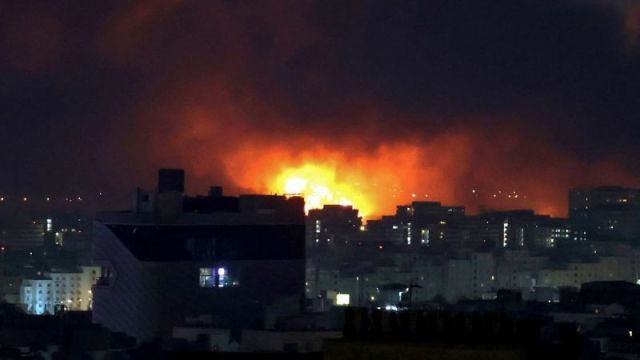

The Week the Middle East Changed: 5 Impactful Realities of the 2026 Gulf Conflict
We spent decades building a global economy on the assumption of a rational Middle East; in one week, that assumption was incinerated. What the world witnessed following the February 28, 2026, “decapitation strike” against the Iranian leadership was not a calculated military response, but the thrashings of a regime in its death throes.
The precision strikes that neutralized Supreme Leader Ali Khamenei and his top military brass were intended to paralyze the Iranian state. Instead, they triggered a regional contagion that has frozen global transit and shattered the energy markets. To understand the gravity of this shift, we must look beyond the immediate carnage and analyze the structural collapses that have redefined the geopolitical landscape.
1. The Collapse of the “Gentlemen’s Agreement”
For years, the United Arab Emirates and its neighbors maintained a fragile, informal non-aggression pact with Tehran. Abu Dhabi and Riyadh explicitly refused to allow their territory or airspace to be used as a launchpad for Western strikes, betting that diplomacy would shield them from Iranian wrath. This was a strategic gamble that failed spectacularly.
Tehran responded to the U.S.-Israeli strikes by launching hundreds of missiles and drones not at the aggressors, but at the very neighbors who had sought to avert the war. By targeting civilian hubs in Dubai and Abu Dhabi, Tehran has traded its remaining regional diplomatic capital for symbolic strikes on civilian hubs, effectively committing geopolitical suicide. This breach of trust has made the isolation of the Iranian regime more permanent than any previous rift.
“Your war is not with your neighbours,” stated Dr. Anwar Gargash, diplomatic adviser to the UAE President. He dismissed Iran’s rationale of self-defense as “unconvincing” and “unreasonable,” noting that the attacks crossed a red line that will result in long-term hostility and distrust.
2. The “De Facto” Closure of the Strait of Hormuz
The global economy is currently reeling from the maritime standstill in the Strait of Hormuz. While the IRGC Navy lacks the surface mass to maintain a total physical blockade, they have achieved a de facto closure through economic terror. With 20 million barrels per day 20% of global consumption passing through this chokepoint, the halt is catastrophic.
Shipping surcharges have exploded by $1,500 to $3,500 per container as war-risk premiums make transit a financial impossibility. The vulnerability of our global infrastructure is now laid bare: alternative pipelines through Saudi Arabia and the UAE can only facilitate 2.6 million b/d, leaving 18 million barrels stranded. Even the recent OPEC+ agreement to boost output by 206,000 b/d has been rendered irrelevant; there is no point in producing more oil if you cannot get it to a tanker. We are witnessing the limits of globalism in the face of localized instability.
3. The Command-and-Control Paradox
Perhaps the most startling reality of this conflict is the total disconnect between Iran’s interim political leadership and its military execution. President Masoud Pezeshkian has spent the week issuing public apologies and announcing a “no-first-strike” policy, yet the IRGC continues to “fire at will.” We saw the literal collapse of the regime’s stability on March 3, when Israeli and U.S. strikes hit the Assembly of Experts in Qom while they were in a meeting to select the next Supreme Leader.
The logistical cost of this chaos is best illustrated by the scenes at Dubai International Airport, where international passengers were ushered down into train tunnels during missile alerts. This isn’t just a military failure; it is a systemic breakdown where the mechanism for political transition was physically incinerated while the military pursued its own independent, destructive agenda against Saudi oil fields and Emirati transit hubs.
4. A Historical Submarine Strike
From a strategic perspective, the sinking of the IRIS Dena on March 4 represents a milestone in naval history. Engaged by a U.S. Navy submarine 40 kilometers off the coast of Sri Lanka, the frigate’s destruction marked the first time a U.S. submarine has sunk an enemy ship in active combat since World War II.
This strike, supported by B-1 Lancer strategic bombers operating across the theater, underscores the “Total War” doctrine being applied. The U.S. is not merely containing Iran; it is systematically dismantling its ability to project power anywhere in the Indian Ocean. The regime, already weakened by the “Twelve-Day War” of June 2025, is finding that its traditional naval tactics are obsolete against the breadth of modern Coalition air and sub-surface supremacy.
5. The “Digital Front” and Internal Dissent
While the interim council attempts to project a united front under “Operation Lion’s Roar,” the Iranian people are conducting a “revenge in digital form.” Persian-language social media is not filled with mourning, but with dark humor regarding the delayed burial of Ali Khamenei. The regime’s loss of the “Digital Front” is absolute, with users mocking the state by suggesting the funeral be held on the government’s “Shad” educational app.
This dissent is fueled by the memory of the January crackdown, where an estimated 36,500 protesters were slaughtered by security forces. The irony of the regime being unable to bury its own leader while it denied mourning rites to thousands of families is not lost on the populace.
One social media user captured the national mood: “For five days the body of that same man has been kept in a refrigerator… What goes around comes around.”
Conclusion: A Fragile Future
The regional order that existed before February 28 is gone. We are now in a period of maximum volatility where the only constant is the demand for “unconditional surrender” from Washington and the defiant retort from Tehran that such a peace is a “dream for the grave.”
As a strategist, one must ask: Is the total decapitation of the Iranian state a path to regional stability, or have we simply created a vacuum that will be filled by the very “fire at will” IRGC commanders who are currently terrorizing the Gulf? The coming weeks will determine if this conflict is the end of a regime, or the beginning of a much wider, more uncontrollable fire.

Leave a Reply