
![‘The Beauty’ Finale Director Breaks Down That Disgusting Transformation Scene, [SPOILER]’s Change of Heart and Who Should Return in Season 2](https://dailyamericandispatch.com/wp-content/uploads/2026/03/download-2026-03-05T151626.910.jpg)

The Price of Perfection: 5 Most Shocking Takeaways from ‘The Beauty’ Season 1 Finale
In the hyper-curated landscape of the modern era, the promise of self-improvement has always been our most seductive narcotic. Ryan Murphy’s The Beauty simply drops the subtext, offering a world where “one shot makes you hot.” But as the Season 1 finale, “Beautiful Betrayal,” makes violently clear, perfection in this universe isn’t a gift it’s a sexually transmitted biological disaster. What began as a controlled pharmaceutical rollout by “The Corporation” has mutated into a global fever dream where the elite are losing control and the human cost is measured in slimy cocoons and shattered identities.
As a narrative architect, I find the finale’s pivot from mere satire to full-scale body horror both inevitable and haunting. Here are the five most shocking takeaways from the Season 1 conclusion.
1. The “Mini-Cooper” Anomaly: An Evolutionary Insult
The most jarring subversion of the “enhancement” trope involved FBI Agent Cooper Madsen. Played with jaded grit by Evan Peters, Cooper attempted to infiltrate the Corporation’s inner circle by undergoing the transformation himself. However, Murphy delivered a grotesque regression instead of an upgrade. Rather than emerging as a statuesque god, Cooper underwent a cellular backfire, regressing into a 12-year-old boy (played by Hudson Barry).
The irony is a sharp critique of a vanity-obsessed culture that fetishizes youth: by seeking the ultimate adult “perfection,” Cooper was stripped of his agency and maturity entirely. The cast reportedly dubbed the character “Mini-Cooper,” a nickname that belies the “uncomfortable” nature of the storyline. As his partner Jordan Bennett herself transformed from Rebecca Hall into the “Beauty” version played by Jessica Alexander discovered, the virus doesn’t just change your face; it can delete your history.
2. Ashton Kutcher’s Left-Handed Villainy and the Homage to Horror Past
Ashton Kutcher’s Byron Forst emerged as a surprisingly nuanced antagonist, but the real brilliance lay in the technical “continuity of character.” To maintain a tether to Vincent D’Onofrio’s “pre-Beauty” version of Byron, Kutcher performed the entire role left-handed, mimicking D’Onofrio’s natural dominant hand even during high-stakes scenes involving firearms and bone manipulation.
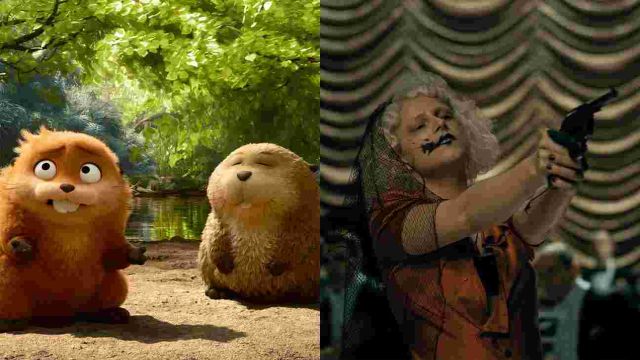
However, the narrative heart of the finale was the tragedy of Byron’s wife, Franny. In a move of staggering cruelty, their sons, Tig and Gunther, forcibly dosed her with the virus. Franny (transformed from Isabella Rossellini into Nicola Peltz Beckham) viewed this “perfection” as an erasure of her lived identity. In a sequence that served as a direct, meta-textual homage to Death Becomes Her the 1992 cult classic Rossellini actually starred in Franny donned the iconic fountain-of-youth outfit before slitting her own throat in front of Byron. While she survived the attempt, she ended the season on life support, leaving Byron a man broken by his own creation. Is his subsequent offer of free boosters and victim compensation a shred of nobility, or just another sales pitch?
3. The Screen is Bloodier than the Page: Perfection as Trauma
For fans of the Image Comics source material by Jeremy Haun and Jason A. Hurley, the TV adaptation is a visceral departure. In the comics, becoming a “Beauty” is a painless, overnight metamorphosis. Murphy, acting as a narrative architect of the macabre, replaces this with a “visceral critique of the Murphy aesthetic.” On screen, the transformation is an agonizing ordeal involving high fevers, melting skin, and the emergence from a “slimy cocoon.”
This shift into body horror reminiscent of the aesthetic in The Substance argues that perfection is not a gift, but a trauma inflicted upon the body. The finale doubled down on this, utilizing a “gorgeously repulsive display of practical effects and sound design” to illustrate that the pursuit of an artificial ideal requires a literal, violent shedding of the human self.
4. The Bella Grant Case and the Rise of “The Deacons”
The tragic arc of teenager Bella Grant (Emma Halleen) served as the season’s most potent cautionary tale regarding the “black market” of aesthetics. Seeking a shortcut to beauty through an unstable, illicit version of the drug, Bella didn’t find perfection; she found mutation. The sight of her mother (Maria Dizzia) discovering a monstrous, mutated creature hiding in the closet signaled the end of the Corporation’s monopoly on the virus.
The stakes are no longer merely corporate; they are existential and political. With 50,000 class-action lawsuits pending and reports that the Secretary of Defense has regressed into a child, the world is in freefall. In response, Dr. Diana Sterling (Ari Graynor) introduced “The Deacons” a fleet of androids and AI systems designed to stabilize the Beauty through nanotechnology. It’s a chilling pivot: if human biology is too volatile for perfection, the Corporation will simply replace the human element with silicon and code.
5. The Final Gamble: The Reversal Agent Cliffhanger
The season closed on a desperate, high-stakes experiment. Dr. Sterling offered a prototype reversal agent, and Cooper desperate to escape his preteen prison volunteered as the guinea pig. The resulting sequence was pure Murphyverse: a “grotesque sack-like transformation” where Cooper’s body buckled and dissolved into a new cocoon.
The final shot was a masterclass in ambiguity. We see an adult hand emerge from the sack one that looks “more age-appropriate,” according to set reports but the horrified expressions of Jordan, Antonio (Anthony Ramos), and Jeremy (Jeremy Pope) suggest the result is anything but a return to “normal.” As the cast hinted, “there are no rules in a Ryan Murphy universe,” and the hand that reached out may belong to something far more unpredictable than the man we once knew.
Conclusion: The Lingering Question
As Season 1 draws to a close, society stands on a precipice. The obsession with aesthetics has led to a global biological collapse, where the cure is as terrifying as the disease. We are left with a world fractured by vanity, governed by AI “Deacons,” and haunted by the monsters created in the pursuit of gods.
It leaves us with one final, haunting question: If the cure makes you a monster, but the virus makes you a god, which shot would you take?



Leave a Reply