

Crispus Attucks and the Propaganda of the Boston Massacre
The Night King Street Bled: A Dramatic Reconstruction
The history of nations is rarely a straight line; it is a jagged path marked by sudden, violent pivots. On the evening of March 5, 1770, King Street in Boston became the site of such a pivot. What began as a localized dispute between frustrated townspeople and a handful of British soldiers rapidly transformed into a seismic shift in the relationship between the British Crown and its American subjects. The blood spilled on King Street was the harvest of seeds sown years earlier in the halls of Parliament the moment the theoretical friction of colonial policy became a visceral, bloody reality.
The night was cold and moonlit, the cobblestones dusted with snow. The atmosphere was already thick with a palpable, sulfurous tension when the auditory chaos began: the “fire” bells at the Brick Meeting House started to ring. In an era where bells signaled communal danger, this was a clarion call. Dozens of residents poured into the restless streets, streaming from Dock Square and narrow alleys toward the heart of the town. They converged near the Custom House, where a lone sentry, Private Hugh White, stood watch over the “King’s chest.”
The spark was pedestrian: a dispute over an unpaid wig-maker’s bill. Edward Garrick, an apprentice, taunted Captain John Goldfinch, claiming he had not paid for a dressing of his hair. When White stepped forward to defend the officer’s honor, the exchange turned physical. White struck Garrick with his musket, knocking him down. Within minutes, a crowd of fifty surged around the sentry, their voices rising in a chorus of derision: “Bloody lobster back! Lousy rascal! Lobster son of a bitch!” Terrified, White retreated to the Custom House steps, banging the butt of his gun against the stone and shouting, “Turn out, Main Guard!”
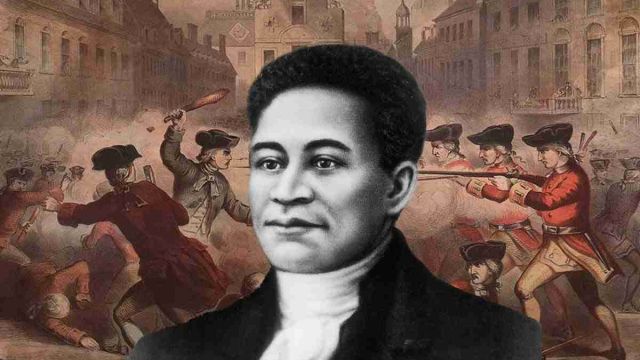
Captain Thomas Preston arrived with seven men from the 29th Regiment, their bayonets fixed but their muskets empty. They pushed through a mob that had swelled to over three hundred. Hemmed in, the soldiers formed a besieged semi-circle. The air was thick with missiles chunks of coal, snowballs, oyster shells, and sticks. Amid the chaos, a tall man of mixed heritage named Crispus Attucks stepped forward, brandishing a cord-wood club and striking Private Hugh Montgomery. As Montgomery rose from the slush, he screamed, “Damn you, fire!” and pulled the trigger.
The first volley was ragged but devastating. Montgomery was followed by a sequence of fire from the other soldiers. Private Matthew Killroy fired into the chest of Samuel Gray, blowing a hole in his head “as big as a hand.” Crispus Attucks was struck by two musket balls in the chest, dying instantly. By the time Preston yelled, “Stop firing!” five colonists lay dead or dying. This local tragedy was immediately seized upon by radical leaders, who understood that this specific blood could fuel a much larger political fire.
The Powder Keg: A City Under Military Occupation
To understand why a dispute over a barber’s bill could trigger a revolution, one must look at the preceding years of military occupation. By 1770, Boston was a city under siege by its own government. The strategic friction of quartering a standing army within a civilian population had turned the urban space into a powder keg.
The roots of this resentment were deeply embedded in the perceived incompetence and arrogance of British leadership. In London, the British Chancellor of the Exchequer, Charles Townshend mockingly nicknamed “Champagne Charlie” after delivering a speech in Parliament while drunk had pushed through the Townshend Acts of 1767. These laws levied duties on glass, lead, paint, paper, and tea to fund colonial administration. To enforce these unpopular taxes and crack down on smuggling, the Crown landed 4,000 troops in Boston in September 1768.
The landing was a calculated insult. The 14th and 29th Regiments debarked at Long Wharf and marched in “insolent parade” past the Town House to the tune of “Yankee Doodle,” a song intended to taunt the provincial Bostonians. The 29th Regiment even featured “Afro-Caribbean” drummers dressed in striking yellow coats with red lapels and trim a visual reminder of the Crown’s global reach. For a town of only 15,000 to 20,000 people, the presence of these soldiers meant that one in every three adult males was a Redcoat.
The occupation was an economic burden as much as a political one. British soldiers, earning modest incomes, competed with local laborers for scarce part-time jobs. This reached a breaking point on March 2, 1770, at John Gray’s Ropewalk. When a soldier asked for work, a rope-maker told him to “go and clean my shithouse.” The resulting brawl between soldiers and laborers was a violent dress rehearsal for the massacre.
The emotional catalyst, however, arrived eleven days before the King Street shooting. An eleven-year-old child of German immigrants, Christopher Seider, was killed by a loyalist informer, Ebenezer Richardson, who fired birdshot into a crowd during a protest. Seider’s funeral was the largest Boston had ever seen, organized by Samuel Adams to symbolize British oppression. By March 5, the city was in mourning and looking for a target for its “secret rage.”
The Art of the Spin: Revere, Pelham, and the Propaganda War
In the aftermath of the violence, the battle shifted from the streets to the printing presses. The interpretation of the event became more historically significant than the facts themselves. The Patriot movement understood that controlling the “collective memory” of that night was essential for uniting the thirteen disparate colonies into a single political body.
The most iconic tool in this propaganda war was the engraving The Bloody Massacre perpetrated in King Street. While Paul Revere’s name is synonymous with the work, it was largely a plagiarized version of a design by Henry Pelham. Pelham furiously wrote to Revere, accusing him of “the most dishonorable action” and claiming Revere had “plundered” him as if on a highway. Regardless of the theft, Revere’s version enhanced with his own political “spin” became the defining image of the era.
Propaganda vs. Reality in Revere’s Engraving:
- The Line of Fire: Revere depicted the British soldiers standing in an orderly, disciplined line, firing in unison on command. In reality, they were a confused semi-circle under assault.
- The Victims: The engraving shows “gentlemanly” victims in fine waistcoats to evoke sympathy from the upper classes. In truth, the crowd was a “motley rabble” of laborers and sailors.
- The Fabrication of Intent: Revere added a sign reading “Butcher’s Hall” above the Custom House and depicted a sniper firing a gun from the window to suggest a concerted scheme to murder inhabitants.
- The Omission of Weapons: To emphasize victimhood, Revere omitted the clubs, ice balls, and oyster shells used by the crowd.
Revere even included an 18-line poem deriding the soldiers as “fierce barbarians” who would eventually be punished “by a judge who can never be bribed.” While Pelham eventually became a loyalist exile, Revere’s propaganda won the hearts of the colonies. However, the actual facts would still have to be settled in a court of law.
“Facts are Stubborn Things”: The Trials and the Search for Justice
In an extraordinary display of legal principle, the defense of the British soldiers was undertaken by John Adams. This was a massive strategic risk; defending the “enemy” could have ended his career. Yet, Adams believed a fair trial was essential for the Patriot image, proving that Americans were governed by law and “civility,” not the whims of a mob.
Adams’ defense was brilliant and uncompromising. He famously told the jury, “Facts are stubborn things; and whatever may be our wishes… they cannot alter the state of facts and evidence.” To secure an acquittal, he intentionally utilized the “motley rabble” description of the crowd, arguing the soldiers acted out of justified fear.
Crucial to the defense was the testimony regarding Patrick Carr, an Irish immigrant and victim of the shooting. Carr’s surgeon testified that on his deathbed, Carr forgave the soldiers. He stated he had seen soldiers in Ireland bear much more before firing and was satisfied there was “no malice.” This “dying declaration” by a man “stepping into eternity” carried immense weight.
The trials resulted in a surprising level of leniency. Captain Preston was acquitted after Adams sowed doubt about the order to fire. Of the eight soldiers, six were acquitted. Two, Matthew Killroy and Hugh Montgomery, were found guilty of manslaughter. They escaped the gallows by invoking the “benefit of clergy,” a legal plea that shifted their punishment from death to branding. As John Adams looked on, the two men held out their right thumbs for Sheriff Stephen Greenleaf to brand them in open court. The trial preserved the integrity of the colonial legal system, even as it further alienated the population from the military.
Martyrdom and Memory: The Legacy of Crispus Attucks
As decades passed, the identity of the victims was reclaimed. Among the fallen, Crispus Attucks emerged as a singular icon. Attucks was a forty-seven-year-old sailor of mixed African and Indigenous heritage his surname deriving from the Natick word for “deer.” Known to some as “Michael Johnson,” a name he likely used to avoid being returned to slavery after escaping from Framingham in 1750, Attucks was the first to fall.
In Revere’s original engraving, Attucks was white-washed, his race erased to make the victims more “palatable” to a 1770 audience. However, in the 19th century, he was resurrected by abolitionists like William Cooper Nell. In his work The Colored Patriots of the American Revolution, Nell positioned Attucks as the “first martyr of liberty.”
This reclamation transformed Attucks from a “rabble rouser” as Adams had described him into a foundational hero. Attucks represents the diverse participants in the revolutionary cause, proving that the desire for freedom was shared among sailors, laborers, and the enslaved alike.
Conclusion: The Spark That Never Faded
The Boston Massacre serves as a testament to how a single night of chaos can be transmuted into a foundational myth. The immediate political fallout was significant: public pressure forced Acting Governor Thomas Hutchinson and Colonel Dalrymple to remove the troops to Castle Island, ending the occupation.
More importantly, the event united thirteen disparate colonies. The Sons of Liberty established annual “Massacre Day” orations, high-profile events that kept the revolutionary fervor simmering for years. These speeches framed the blood spilled on King Street as a sacred sacrifice, ensuring that the tension never truly dissipated until the first shots at Lexington and Concord.
As we look back at March 5, 1770, we are reminded that history is shaped as much by the stories we tell as by the events that occur. The “stubborn facts” of King Street show us a moment of tragic, human error but the narrative of the Boston Massacre shows us the birth of a nation. How might a single moment of violence still shape how we view justice and freedom today?



![‘The Beauty’ Finale Director Breaks Down That Disgusting Transformation Scene, [SPOILER]’s Change of Heart and Who Should Return in Season 2](https://dailyamericandispatch.com/wp-content/uploads/2026/03/download-2026-03-05T151626.910.jpg)
Leave a Reply