
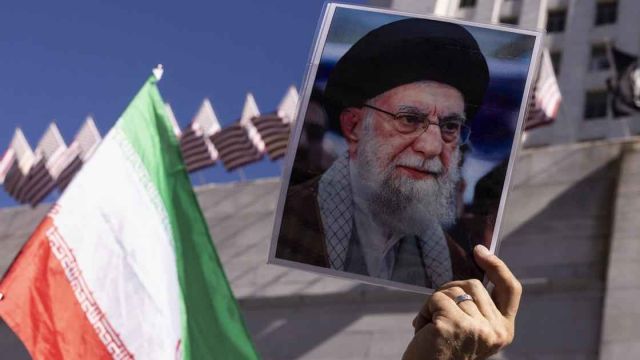
The Compound and the Crater: How “Operation Epic Fury” Dismantled the Khamenei Era
For nearly four decades, the political landscape of the Middle East was anchored by a single, unwavering constant: the rule of Grand Ayatollah Ali Khamenei. Since 1989, the Supreme Leader had survived wars, internal uprisings, and waves of international sanctions by retreating into the shadows of his Tehran compound. His final years were defined by a reclusive existence and a claustrophobic, five-minute descent into the earth the time it took for an elevator to reach the heart of a bunker designed to withstand the end of the world.
But on the morning of February 28, 2026, that decades-long stability vanished in a matter of seconds. The “decapitation” of the Islamic Republic’s leadership was not the result of a slow-burning revolution or a years-long hunt like the one for Saddam Hussein. It was a sudden, violent eruption of high-altitude geometry that caught the Supreme Leader aboveground, ending the second-longest leadership in modern Iranian history before the capital’s morning commute had even hit its stride.
The Daylight Audacity: Tactical Shifts and Strategic Vertigo
The execution of what is now known as “Operation Epic Fury” defied the conventional military wisdom that favors the cover of darkness. Instead, at 8:10 am local time, the Israeli Air Force bolstered by precise intelligence from the CIA launched a massive, wildly bold daytime attack. Israeli jets dropped 30 bombs directly onto the Supreme Leader’s residence, catching the leadership at a moment of maximum vulnerability.
The timing was not a matter of chance. Intelligence had tracked a specific meeting of the senior defense council; the strike neutralized not only Khamenei but at least five of his most senior advisors. This operation marked a radical departure from the strategic hesitation of 2025. In June of that year, during the “Twelve-Day War,” President Donald Trump had reportedly vetoed a similar assassination plan. By early 2026, however, the diplomatic track had evaporated, and the decision was made to strike the head of the “Axis of Resistance” while he sat in plain sight above the safety of his bunker.
“It was the assassination of the century. While the search for Saddam Hussein took nine months during the 2003 invasion of Iraq, the operation to neutralize the head of the Islamic Republic was executed with a speed and precision that has left the region in a state of strategic vertigo.” – The Telegraph
The Domestic Paradox: A Nation Divided
Confirmation of Khamenei’s death on March 1 triggered a domestic reaction that exposed the raw, fractured nerves of the Iranian public. While the state declared 40 days of official mourning and seven days of public holidays, the atmosphere on the streets was a study in contradictions.
- State-Sanctioned Grief: Massive, organized crowds gathered at the Imam Reza shrine in Mashhad and Enqelab Square in Tehran, with state media broadcasting images of mourners collapsed in visceral grief.
- Civilian Jubilation: Simultaneously, digital windows into the country showed a very different reality. Fireworks and cheers were reported in:
- Isfahan
- Karaj
- Kermanshah
- Shiraz
- Qazvin
- Sanandaj
- Izeh
The depth of the divide was most poignantly captured in Dehloran, where citizens were filmed cheering as a bronze statue of the Supreme Leader was toppled to the ground, a scene reminiscent of the fall of Firdos Square in 2003.
The Succession Shadow: Institutional Gridlock
The vacuum left in the wake of the strike is not merely political; it is structural. Because the position of “Vice Supreme Leader” was abolished in 1989, the regime was left with no constitutional heir apparent. In the immediate aftermath, an interim three-member Leadership Council was formed to manage the state’s affairs, consisting of Alireza Arafi (a member of the Assembly of Experts), President Masoud Pezeshkian, and Chief Justice Gholam-Hossein Mohseni-Ejei.
However, the real struggle for the future of the Islamic Republic is taking place behind closed doors. The 88-strong Assembly of Experts, the body legally tasked with choosing a permanent successor, is currently under intense pressure from the Islamic Revolutionary Guard Corps (IRGC). The IRGC is pushing for a permanent appointment that bypasses traditional legal norms to ensure the preservation of their own interests. While figures like Mojtaba Khamenei remain in the conversation, the lack of a consensus candidate threatens to pull the regime’s competing factions apart.
The Billion-Dollar Choke Point: Economic Shockwaves
The death of Khamenei acted as a direct hit to the nervous system of global commerce. Within hours, the Strait of Hormuz the world’s most critical energy artery became an effective no-go zone. The loss of a single political figure instantly placed 20% of the world’s oil and a massive share of Liquefied Natural Gas (LNG) exports under immediate threat.
Economic Ripple Effect Impact and Description
Oil Price Spike Brent crude futures surged 13% to $82.17 per barrel, hitting a 14-month high.
Shipping Closures At least 9 LNG carriers diverted course; transit through the Strait effectively halted.
Airline Suspensions Major carriers, including Emirates, suspended all operations to regional hubs like Dubai.
Insurance Crisis Underwriters invoked seven-day termination clauses, effectively cancelling coverage for Mideast vessels.
The Collateral Tragedy: The Minab School Strike
The narrative of a “surgical” operation was tempered by the grim reality of the wider air campaign. The most significant mass casualty event occurred in the southern city of Minab, where a strike hit a girls’ elementary school. Iranian state media has confirmed a death toll of 148 victims, with nearly 100 others wounded.
This tragedy has become a potent symbol for international critics of the operation. While Benjamin Netanyahu and Donald Trump characterized the campaign as a pursuit of justice, the nearly 150 small coffins in Minab have complicated the global conversation, turning a moment of tactical triumph into one of humanitarian scrutiny.
The Morning After: Three Trajectories for Tehran
As the dust settles over the rubble of the House of Leadership, the international community is monitoring three primary trajectories for Iran’s future:
- Regime Continuity: Often described as “Khamenei-ism without Khamenei,” this path involves the rapid installment of a hardline cleric who maintains the current theocratic status quo.
- Military Takeover: Given the IRGC’s status as an entrenched political and economic powerhouse, a formal or informal military coup could see the clerical establishment sidelined in favor of a security-first state.
- Regime Collapse: The most volatile scenario, where the combination of elite infighting and continued street protests leads to a total breakdown of central authority.
The coming weeks will determine if the strike on February 28 truly initiated regime change or if it was merely a change of “bulb” in a fixture where the IRGC provides the real power. Decapitation is a potent military tool, but in the labyrinthine politics of the Islamic Republic, a headless state can remain dangerous long after the first strike.


Leave a Reply