
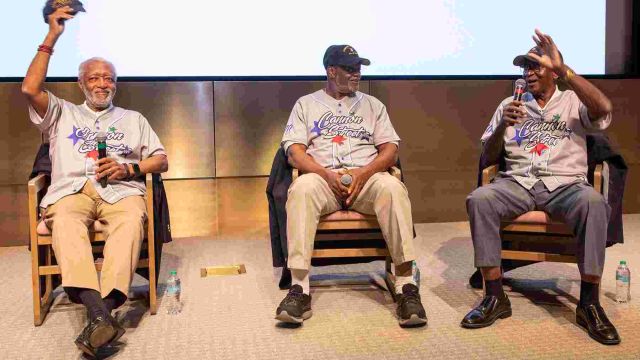
The Legacy of the Cannon Street All-Stars
Every child who picks up a baseball bat shares a singular, shimmering dream: making it to the Little League World Series in Williamsport, Pennsylvania. For the 14 boys of the 1955 Cannon Street YMCA All-Stars, that dream was not just a fantasy; they were talented enough to earn it. As the first Black Little League team in South Carolina, they were a powerhouse squad of 11- and 12-year-olds who did everything required to reach the national stage.
However, a cruel paradox defines their legacy in the annals of American history. The Cannon Street All-Stars became the most significant amateur team in baseball history not because of the games they won, but because of the games they were never allowed to play. Their journey sparked what is now known as “Little League’s Civil War,” a confrontation that forced the “National Pastime” to choose between its own rules of fair play and the rigid, suffocating structures of Jim Crow.
The “Technicality” That Masked a Movement
In July 1955, the All-Stars registered for the Charleston city tournament, a move that sent shockwaves through the segregated establishment. Before the boycott even began, white league officials actually scouted the Cannon Street team at their local field, Harmon Field. They didn’t like what they saw: a strong, disciplined team with an excellent chance to defeat white youngsters on the field.
The reaction from the white leagues was swift and total. All 61 other teams in South Carolina withdrew from the competition rather than risk an integrated game or a defeat at the hands of Black players. While Little League President Peter McGovern initially supported the team, the local establishment utilized a “technicality trap” to silence the movement.
George “Buck” Ransom, the regional director, eventually declared the All-Stars ineligible for the World Series. He cited a rule stating that teams must “win on the field” to advance, effectively punishing the children because the adults refused to play them. McGovern ultimately folded to the pressure, likely fearing the “blood on his hands” that segregationists warned would come from racial violence if the team traveled to Georgia.
“I believe the adults, they knew better because of the technicalities. I didn’t know about the intricacies of that, but we always believed we’d play until we got to Williamsport and the reality started.” – John Rivers, Team Shortstop
The Great Secession: The Birth of Dixie Youth Baseball
The exclusion of the Cannon Street team was a high-stakes political standoff fueled by the most powerful segregationist leaders of the era. When Little League’s national office refused to officially authorize a segregated tournament, white Southern officials staged a mass exodus. They formed the “Little Boys League” later rebranded as Dixie Youth Baseball which explicitly prohibited Black players until 1967.
This “Great Secession” was orchestrated by figures who viewed integrated sports as a direct threat to the Southern way of life:
- Senator Strom Thurmond: The South Carolina politician called for Southern states to “resist integration by any lawful means,” putting immense pressure on league directors to block the All-Stars.
- Governor James F. Byrnes: A former Supreme Court Justice who threatened to close the state’s public schools entirely rather than integrate, framing the tournament as a battle for the “civilization” of the South.
- Danny Jones: The state director who resigned from Little League to draft the charter for the new segregated organization, which grew to include hundreds of teams across the former Confederacy.
- Governor Marvin Griffin: The Georgia governor who used a dramatic metaphor to describe the threat of integrated baseball, stating, “One break in the dike, and the relentless sea will rush in and destroy us.”
A 5,000-Voice Protest: “Let Them Play!”
Though barred from the bracket, the Cannon Street All-Stars were invited to Williamsport as “guests” of the tournament. In the dormitories of Lycoming College, the children proved how unnecessary the adults’ fears really were. Away from the politics of their elders, the Black and white players lived together, talking only about who was the best pitcher or the biggest home run hitter.
The atmosphere shifted from quiet camaraderie to public defiance when the team was introduced to the crowd before the championship game. As the boys walked onto the field to warm up, a single voice boomed from the bleachers, sparking a spontaneous, rhythmic chant from 5,000 spectators. “Let them play! Let them play!” the crowd roared, the sound swelling until the very earth seemed to move.
“We were so young… All we knew was that we were good and could have beaten any one of those teams.” – Maurice Singleton, Team Outfielder
The Long Road Home: A Stark Reality Check
On August 28, 1955, the boys boarded an old, borrowed school bus for the 740-mile trip back to Charleston. The journey was a physical ordeal; the non-air-conditioned bus broke down multiple times and even caught fire just a few miles from home. Yet the mechanical failures paled in comparison to the news that reached them during the ride: 14-year-old Emmett Till had been brutally murdered in Mississippi.
For the 12-year-old players, the connection between the baseball field and the open road became a traumatic loss of innocence. They realized they were returning to a world where the stakes of being Black were far higher than a forfeited game. The “terrorism” of the era settled into their bones, transforming a sporting injustice into a lifelong weight.
“I got to a point after that story; I would not be on the same side of the street with a white woman. And so, the terrorism that was supposed to come from that, did work. It worked on many levels.” – John Rivers, Team Shortstop
The Legacy of Forgiveness and Self-Correction
History possesses a remarkable capacity for self-correction, even if the arc of justice is agonizingly slow. Since 2002, the surviving members of the team including John Rivers, Leroy Major, and David Middleton have finally received the recognition denied to them as children. They have been honored at the Baseball Hall of Fame in Cooperstown and were finally awarded their 1955 South Carolina state championship banner.
Today, their story is a cornerstone of the Hall of Fame’s The Souls of the Game exhibit. Despite the “stolen dreams” of their youth, the surviving All-Stars have emerged not as victims of bitterness, but as emissaries of grace. Leroy Major, a former Marine and school teacher, has spent his later years ensuring the story serves as a lesson in reconciliation rather than resentment.
“The bitterness is gone. If you hold that bitterness in, it’s going to eat you up. You can’t hate. You have to let it go… I want to teach love.” – Leroy Major, Team Pitcher
Conclusion: A Game Still in Progress
The story of the Cannon Street All-Stars reminds us that the “National Pastime” was once a gatekeeper of exclusion rather than a field of dreams. While the recognition of the 21st century cannot return the summer of 1955 to these men, it ensures their sacrifice is no longer a “lost” chapter of the civil rights movement.
As we look at our modern institutions, we must ask ourselves: where are the “stolen dreams” of today? The legacy of the 14 boys from Charleston serves as a permanent reminder that the game isn’t truly won until the field is open to everyone. We owe it to their memory to ensure that no child’s talent is ever again sidelined by a “technicality” of hate.



Leave a Reply